What happens inside 29 minutes
Six moves take an attacker from the first compromised computer to the next. Where does the time go, which steps can disappear, and where does the SOC still have a chance to intervene?
In my last article I wrote about one number: 29 minutes. That is how long, on average, an attacker needs today to get from the first compromised computer to the next one. For defenders, it is the last chance.
A number like that is easy to quote and hard to picture. So this time I want to slow it down. What actually happens inside those 29 minutes? What does the attacker do, step by step, between getting in and moving on?
Six moves
Attacks differ, but their skeleton is surprisingly similar. Most intrusions go through roughly six moves. They map to the tactics of the MITRE ATT&CK framework, which the whole industry knows: Initial Access, Discovery, Credential Access, Privilege Escalation, Defense Evasion and Lateral Movement. Some take seconds, others swallow most of the time.
Nobody puts a stopwatch on each step separately. So the durations in the picture are not statistics but an estimate from practice: how long each move usually takes compared with the others.
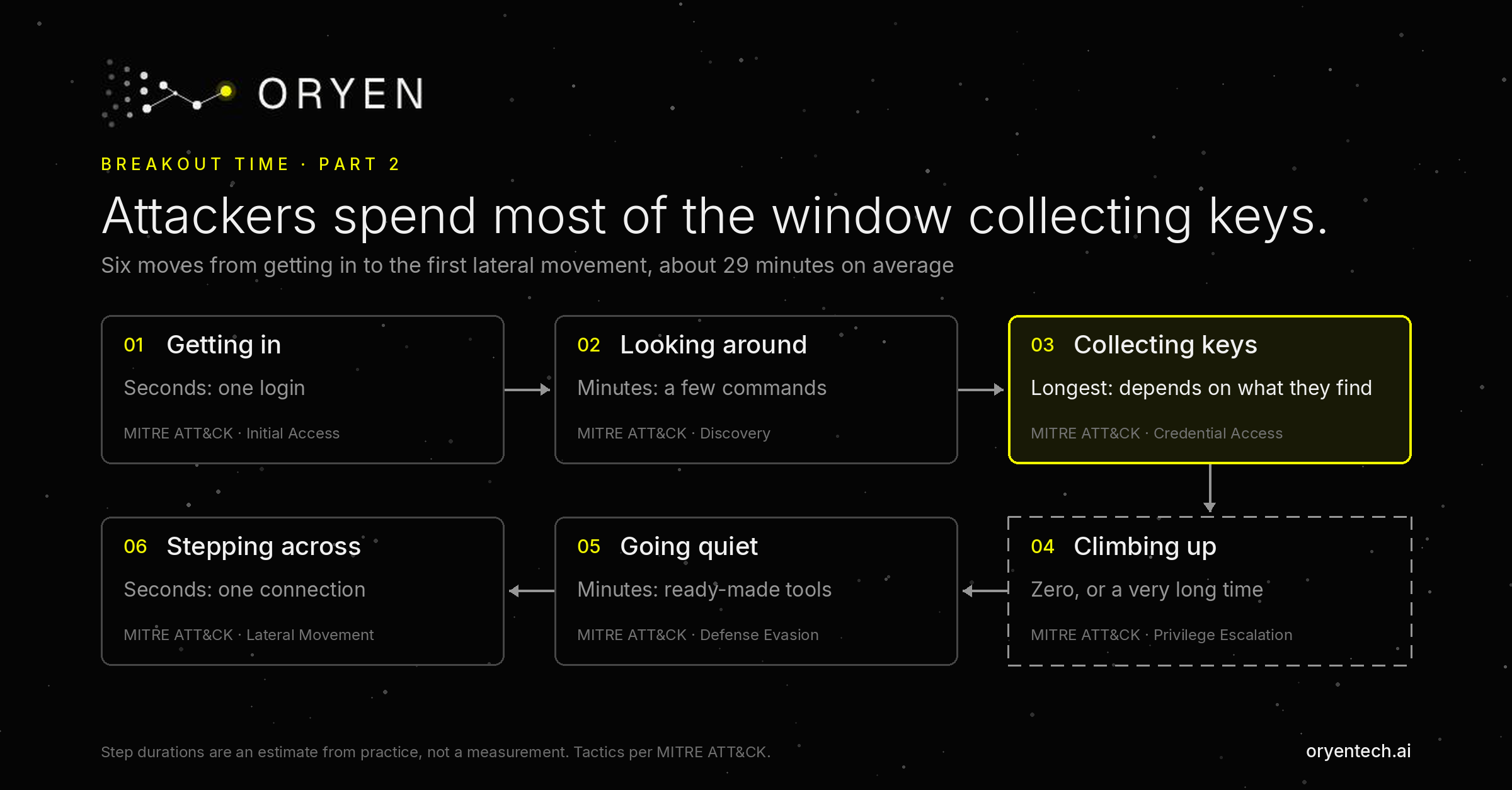
The highlighted move usually takes the most time. The dashed one is the step that experienced attackers increasingly do not need at all.
Six moves up close
01 Getting in: with a key, not a crowbar
The classic picture of a break-in is wrong. Today an attacker usually breaks nothing. They simply log in. To the VPN, to email, to remote access, with a valid username and password they bought, phished or guessed somewhere.
The other door is people. A fake login page. A convincing email. Or just a call to the help desk from someone who has “just lost their phone” and needs their MFA reset.
From the SOC’s point of view, minute zero usually looks like a successful login. Nothing more.
How long: seconds. All the preparation, collecting passwords and writing emails, happened long before the clock started.
02 Looking around: with your own tools
Once inside, the attacker needs a map. Who am I? Which groups am I in? Where are the domain controllers, the file servers, the backups? The answers come from tools that sit on every Windows computer: the command line, PowerShell, directory queries.
There is nothing foreign to find. An administrator checking the network and an attacker mapping it type almost the same commands.
How long: minutes. An experienced attacker has scripts ready. A few commands and the map is done.
03 Collecting keys
The first account is rarely the one the attacker is after. So they look for more keys: passwords saved in browsers and password managers, credentials in the computer’s memory, service accounts with weak passwords that can be cracked offline.
Every new key opens new doors. And every one is real and valid. Using it raises no alarm on its own.
How long: usually the longest of all the moves. Here the attacker depends on what they find in the network. If an admin password sits in the memory of the very first computer, it takes minutes. If they have to search and crack, it takes most of the window.
04 Climbing up, or not
Textbooks put privilege escalation here: exploiting a flaw to become an administrator. It still happens. But more and more often, it is not needed. Weak and reused passwords, gaps in MFA and poorly managed local admin passwords give attackers high privileges quickly and for free. When the stolen key already opens the server room, there is nowhere to climb.
How long: either zero, or a very long time. Without a privileged account it is trial and error with an uncertain result. With one, this move disappears completely. This is where the most time is lost or saved.
05 Going quiet
Before moving on, a careful attacker turns the noise down. They switch off or work around security tools, hide inside legitimate remote-management software, or give their tools the names of ordinary system files. The goal is simple: when the move comes, it should look like routine IT work.
How long: minutes. Attackers have ready-made toolkits for this. More routine than art.
06 Stepping across
And then the move itself. Most often through Remote Desktop (RDP). Then through file sharing, remote command execution tools and, more and more, through the cloud, where a stolen identity travels between services without touching a single laptop.
How long: seconds. One connection, one login. At that moment the clock stops. The incident is no longer on one machine. It is in your network.
Where the attacker loses time, and where they save it
Put the six moves side by side and something interesting appears. The beginning and the end are lightning fast. Getting in and stepping across take seconds. Looking around and going quiet are a few minutes of routine.
Most of the window happens in the middle: collecting keys and climbing up. Here the attacker has no certainty. They have to search, try, wait. And in my view, this is exactly where the window has shrunk the most in recent years. Not because attackers search faster, but because more and more often they do not need to search at all. They bring the key with them.
For defenders, this means two things. First: the longest move is also the best opportunity. Whoever notices strange password collecting still has time. Second: that opportunity is shrinking. An attacker with a privileged account skips the middle part, and half an hour turns into a few minutes.
The window does not shrink evenly. What disappears is exactly the part where we had the best chance.
What it means for the SOC
When every move looks normal on its own, judging alerts one by one is the wrong game. The question is never “is this login suspicious?” It is: “what else did this identity do in the last half hour, and does it make sense?”
Answering that means pulling evidence from five or six places at once, for every alert, before the attacker reaches move six. An experienced analyst can do it well. No analyst can do it for every alert, within half an hour, day and night.
That is where machines belong. They can collect evidence from identities, endpoints, the network and the cloud the moment an alert arrives, and compare it with what an attack chain looks like according to MITRE ATT&CK: from getting in, through collecting keys, to stepping across. Not to guess, but to prove. What is provably normal can be closed, with the evidence attached. What is not goes to a person, with the whole story already on the table.
The attacker needs six moves and about half an hour. We need to see the story by move two.
Now imagine that in two years, maybe even sooner, the whole window will be just under ten minutes. That is where today’s trend leads if it keeps the same pace. Six moves in ten minutes. How many of those minutes will be left for us?
Michal Martínek, CEO, Oryen Technologies · michal.martinek@oryentech.ai · oryentech.ai